


Inside the Drone Brain
Before a drone can do anything interesting, a quiet conversation must happen between silicon, sensors, and radio waves.
At the core is the flight controller: the board that fuses IMUs, barometers, GNSS and pilot inputs into thousands of control decisions per second. Around it sits electronic speed controllers that modulate motor power, long‑range RF links that carry commands and telemetry, and positioning modules that keep the vehicle where it is supposed to be in three-dimensional space.
In a mission‑critical setting, this avionics stack has a non‑negotiable job: keep the aircraft stable, responsive, and recoverable even when individual components misbehave or the RF environment turns hostile. That means redundancy, low‑latency links, jam‑resistant signalling, and hardware that is compact and power‑efficient enough not to steal payload or endurance.
ZeroDrag starts from this engineering reality.
Avionics First, Platform Next
ZeroDrag builds the electronics layer as a cohesive system rather than a shelf of parts.
On the RF side, they design long‑range, bi‑directional links that have been exercised over tens of kilometres, with both NDAA‑aligned and commercial variants so integrators can design to different compliance regimes without changing the rest of the stack. On the control side, their autopilot family spans from disposable, single‑use boards to high‑end controllers with dual IMUs, dual power domains and advanced navigation - all sharing a common, solder‑free, connectorized footprint.
The same philosophy shows up in propulsion and navigation. ESCs are built around 32‑bit architectures with proprietary firmware aimed at squeezing more useful flight time out of the same airframe, while GNSS modules combine RTK‑grade positioning with IMU, compass and barometer on a CAN‑bus backbone for long‑distance, noise‑resilient integration. Analog video transmitters, tuned for sub‑millisecond latency and better jamming resilience than typical digital links, sit further along the roadmap.

The result is an avionics kit where mechanical layout, electrical interfaces and software expectations are aligned by design, not negotiated one integration at a time.
The System Problem in Drones
Most drone stacks today are assembled like custom PCs from a decade ago: different vendors for the motherboard, graphics card, storage, power supply, and drivers — except here, the machine is supposed to fly.
OEMs routinely source flight controllers, radios, ESCs, GNSS, payloads and ground systems from unrelated suppliers with different design assumptions and support philosophies. That fragmentation shows up as brittle integration, inconsistent reliability, and long debugging cycles whenever a subsystem changes revision or goes out of stock.
Overlay that with policy. India has explicitly discouraged imports of fully built drones, while still allowing controlled imports of sub‑components to encourage domestic assembly and R&D. In the US, NDAA restrictions and related rules push defence and federal buyers away from certain foreign platforms and even from critical subsystems like cameras, radios and flight controllers. Both directions point to the same outcome: demand for trusted, interoperable, non‑Chinese avionics is only going one way.
This is the context in which ZeroDrag is operating.
ZeroDrag’s Architecture Bet
ZeroDrag’s core bet is that the industry will standardise around a few robust avionics ecosystems rather than perpetually stitching together bespoke stacks.
To earn that position, they have made three important engineering choices:
Full‑stack coverage. Instead of focusing on a single board, they cover comms, autopilots, ESCs, GNSS and, over time, ground stations, FPV goggles and specialized payloads. That lets OEMs collapse supplier count for their core electronics into a single, coherent ecosystem.
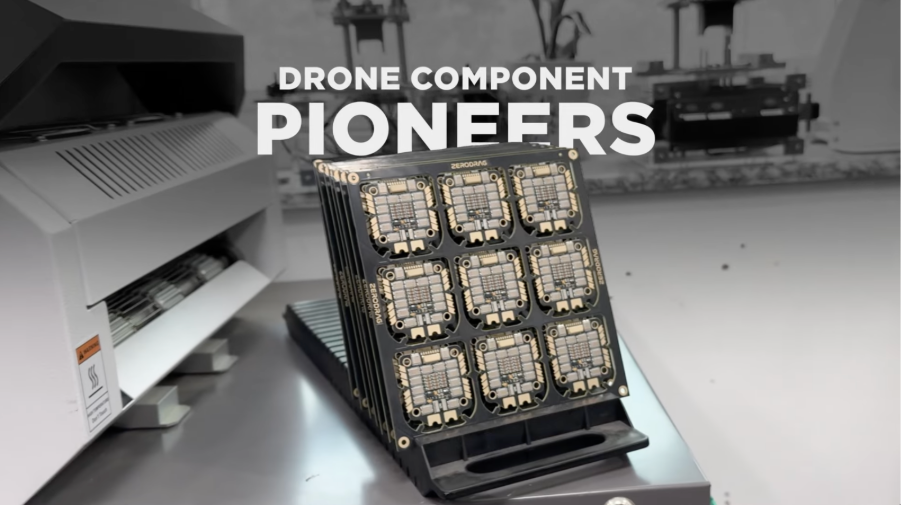
Solderless, standardized integration. Connectorized layouts and a common 30.5×30.5 mm‑style footprint cut assembly times from hours to well under an hour, and make it straightforward to swap boards across performance tiers without redesigning the vehicle.
SWaP‑first design. By aggressively shrinking board size, weight, and power draw, they free up budget for payloads and endurance - especially valuable for ISR and other defence use cases where every gram and watt translates to range or sensor quality.
On top of that sits proprietary IP: ESC firmware tuned for longer flight times than typical commodity controllers, dual‑band RF designs to better tolerate jamming and interference, and redundancy‑first layouts across the stack.
This is what infrastructure looks like in drones: a coherent set of choices that make everyone else’s job easier.
Why This Fits TVC’s Lens
At TVC, we like companies that do two difficult things at once: solve a hard engineering problem and sit in the flow of a structural transition.
On the engineering side, ZeroDrag is doing the unglamorous work of turning fragile hobbyist‑style stacks into something that looks and behaves like avionics - with clear interfaces, redundancy, lifecycle guarantees and a roadmap that extends from the airframe into the operator’s hands. On the market side, policy in India and abroad is pushing buyers to look for secure, non‑Chinese electronics they can standardise on without sacrificing performance or economics.
We also like that ZeroDrag empowers OEMs rather than competing with them. By focusing on subsystems instead of full drones, they position themselves as an enabling layer that integrators can build on, not as a rival for end‑customer mindshare. That tends to produce deeper, longer‑lived relationships and a more resilient business over time.
The Team Behind the Stack
The technical ambition would not matter without the right people to carry it.
Zero Drag’s founding team blends years of hands‑on UAV and avionics work with deep PCB design and systems engineering experience. The CEO brings a mechanical and UAV background and leads product and R&D; the COO comes from a long stint in IT and operations, anchoring procurement, finance and compliance; the CTO has decades in PCB and electronics design, driving miniaturisation and reliability. Surrounding them is a small but focused group across PCB engineering, industrial design and business development.
We have been tracking the founders since before this round, and have seen them iterate through prototypes, shipping products and a clearer articulation of the “full avionics stack” thesis over several years. That patience and compounding of insight is something we look for in system‑level plays.
What Has to Go Right
This is not an easy business. Certification regimes, export controls, evolving standards and entrenched incumbents are all real constraints. ZeroDrag will need to keep investing in engineering depth, support infrastructure, and global go‑to‑market to match the ambition of its stack.
But the direction is clear: the world is asking for trusted drone electronics with better integration, better lifecycle guarantees, and less geopolitical risk in the supply chain. Someone will become the default avionics partner for this decade of drone adoption.
We invested because we believe ZeroDrag has a real shot at being that partner - quietly powering missions from inside the drone’s brain.

